Tuesday, July 26, 2011
Sugarhouse Community Garden (Salt Lake City, UT)
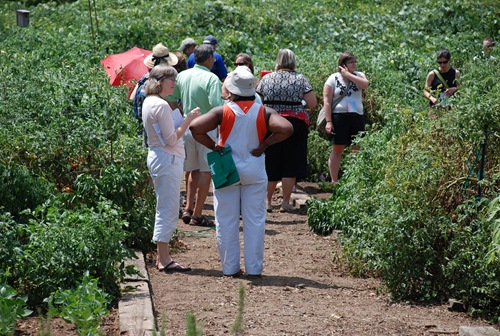
Beds are built right on top of the asphalt. The gardeners laid down some wood chips in the pathways, to reduce the temperature. A nice thing about leaving some of the pathways bare, though, is that it's easier for people to maneuver around, especially if they are in a wheelchair. Pluses and minuses, I guess.
This is the garden's first growing season, in July. I'm looking forward to seeing how the garden looks by the end of the season. Will the crops have enough root space to grow full size? Will there be enough water?
Another interesting thing about this garden is that they opted not to use drip lines or sprinklers. Everything is hand watered by each gardener.
Monday, October 11, 2010
Salt Lake Community College Community Garden (Salt Lake City, UT)
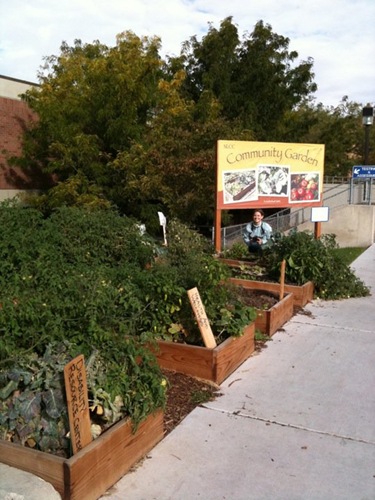
Can the word community be repeated any more times? Brit and I stopped by this new garden at the community college today. Isn’t it lovely? The folks in the marketing department have really outdone themselves with the bright sign, visible all the way across the parking lot when you first drive onto campus.
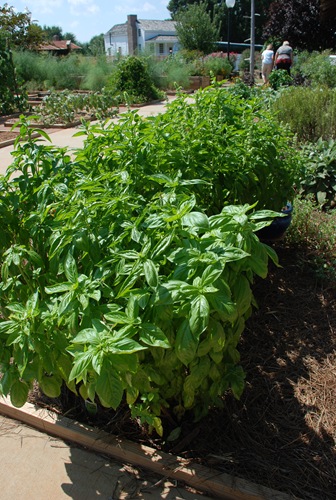
Each raised bed (made from redwood and an incredible potting soil mixture) is tended by a different department or individual. A collective herb area adds pizzazz. Jason is the student who spearheaded the project, and Ann, at the community service center on campus, has spearheaded a series of events at the garden. They’ve brought a gardening workshop and special speaker to the site in its first year.
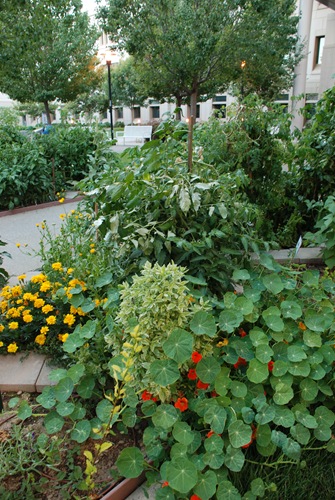
The goals of the garden are to foster greater sense of community on campus and to educate people about food and agriculture issues. It’s one of a growing number of gardens on college campuses that are sweeping the nation! Here are some more pictures to enjoy. (Can you believe these crops in the middle of October?!?)
Saturday, August 14, 2010
Salad Bowl Garden (Davis, CA)
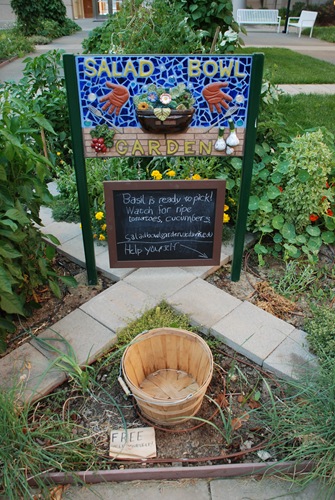
I posted about this garden a few weeks ago, but I just got some new photos in, and couldn’t resist adding them here. (You may recall the garden looked like this, not too long ago.)
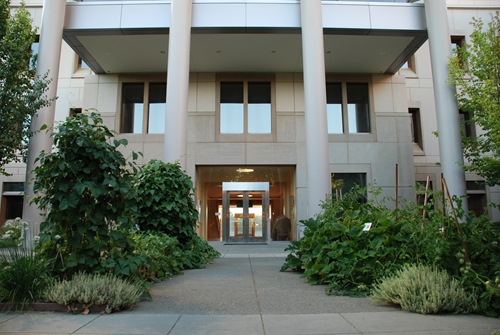
This is a garden started by students a couple years ago, right in the middle of campus at UC Davis. It’s in front of the fancy Plant and Environmental Sciences building. Yep, they just tore up some lawn and planted this biointensive garden full of veggies and flowers!
The idea is that anyone can pick and eat food directly from the garden during lunch breaks, or take extra produce home with them at the end of the day. It’s a demonstration garden, a little oasis on campus, and a gathering place for visitors and volunteers.
Here are some highlights:
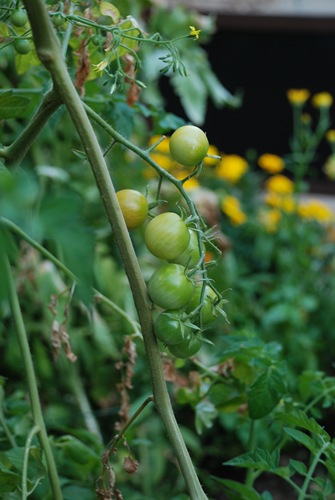
Red tomatoes never last long on the vine here. There are lots of green ones, though!
The garden flanks the entrance to the Plant and Environmental Sciences building. Appropriate, right?
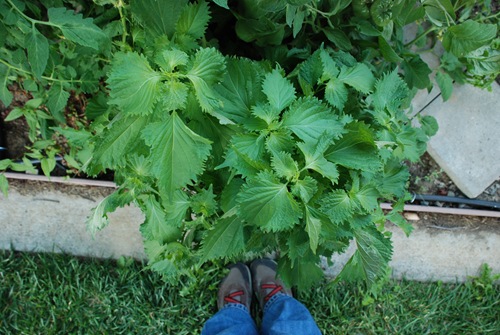
Props to the person who can name this Asian green.
I totally love the arching trellis for this cucumber plant. (It’s made out of remesh and some wooden stakes. So easy!)
Labels are everywhere.
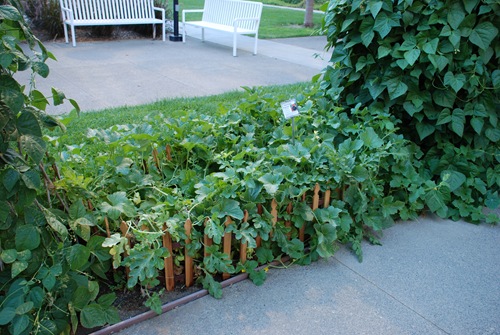
We installed a little, mobile fence for the exuberant watermelon patch. Every time I walk past, I fold another escaping vine back into the corral.
Also, check out this news video about the garden’s spring celebration. Margaret Lloyd is the garden’s rockstar coordinator.
Thursday, August 12, 2010
Heritage Village Community Garden (Atlanta, GA)
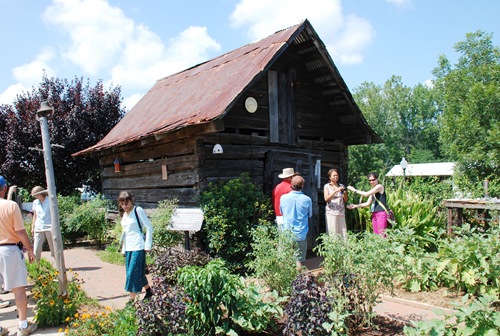
A corn crib was moved onto the site, creating ambiance and a place to stash supplies. Cement pathways make accessibility easy. (A more permeable surface, like decomposed granite, could be just as accessible and more ecologically friendly. I’m not sure why they opted away from that.)
A newly constructed “outhouse” is actually a nice restroom. We were duly impressed. On-site restrooms are the gold standard for community gardens.
The plots were looking good, especially for an unusually hot, dry growing season. I should also mention that our hosts here were superbly gracious, confirming everything you hear about Southern hospitality.Thanks, ya'll!
Heritage Village Community Garden
American Community Gardening Conference 2010
I just got back from the annual American Community Gardening Conference, which was held in Atlanta, GA this year!
News to report: I did not melt under the hot, Georgia sun. I met lots of amazing, down-to-earth people building communities and gardens across the country. I visited some bonafide Southern gardens. And, I got completely soaked in a rainstorm at the annual barbeque, but it was totally worth it.
A blues band played on the porch while we ate ribs, corn, and sweet potatoes. yum!
Visiting the Heritage Village Community Garden, one of the Henry Gardens near Atlanta. The building is an old corn crib from the neighboring farm.
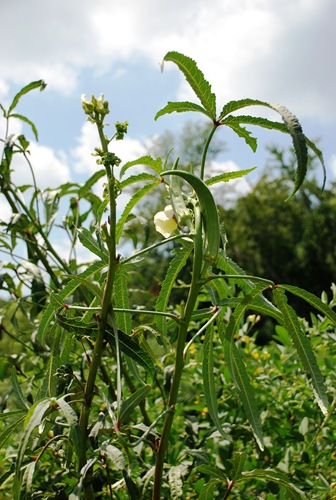
Okra!
One of my favorite parts of the conference was the talk by keynote speaker Yvonne Sanders Butler, who started a sugar-free policy at her school in Atlanta, and has become an author and major activist for better nutrition (and physical exercise) in schools. Totally inspiring!
Monday, July 19, 2010
Growing Power (Milwaukee, WI)
Will Allen at Growing Power has been getting more and more press lately for the work he’s been doing in Milwaukee and Chicago, so it seems timely to share some photos and thoughts from my visit to his farm. Basically, Growing Power is an enterprise that hires local youth (and others) to grow food in the city, bringing fresh, local, organic food to places that need it the most. The organization has been able to do this (and about a billion other things) so well that it’s become something of a gold standard among urban farmers and activists. Here’s how Will Allen puts it:
We share everything we learn, pass it on, and hope they’ll pass it on to others. That’s how change happens, and a revolution comes about. I’m calling it that now, the Good Food revolution, because that’s exactly what it is. (source)
It would be exhausting to describe everything that happens at the one-acre farm, so I’ll just choose a few highlights. Since I’m a garden geek, I’m just gonna focus on the technical stuff, because it doesn’t always get the most press and, honestly, it’s pretty darn cool.
First is the farm’s intensive use of red wiggler worms to produce nutrient-rich compost for the greenhouse and outdoor gardens. These little worms live in numbered bins inside the greenhouse (above) as well as in huge piles that line the outside of the buildings. They eat food scraps that are gathered from around the city in massive quantities (I think this involves full size trucks making deliveries once a week or so). As the worms and natural microbes break down the food scraps, heat is generated, enough even to keep the worms alive and chowing down all through the cold, Wisconsin winter.
Second is the farm’s highly integrated aquaculture system, raising fish and plants in conjunction. (The fish “fertilize” their tank water, which is pumped past filters and growing greens, then back to the tanks.)
Then there are the other farm animals (goats! ducks! turkeys!), not to mention the outdoor hoop houses, the biogas digester, and the electric compost sifter (photos below). Then of course there is all the programmatic stuff that Growing Power does: the farm stand, the apprenticeship program, youth training, workshops, and advocacy .
Frankly, when I met Mr. Allen at the farm, at the end of a long summer day, he seemed a little bit exhausted, and I couldn’t blame him. He wears about a gazillion hats and has the relentless passion of an activist, teacher, inventor, farmer and spokesperson, all rolled into one. I get tired just thinking about it. The result of all this work and care, though, is a beautiful thing. In short, Growing Power and Will Allen deserve the hype. They are totally awesome.
Now for some more photos! Here’s that sweet compost sifter, made from an old dryer:
Using sifted compost to prepare seedling flats:
An old barn sits on the site, a relic of Milwaukee’s agrarian past.
Everywhere you see pots of micro-greens, growing in vermicompost. It’s the farm’s main cash crop.
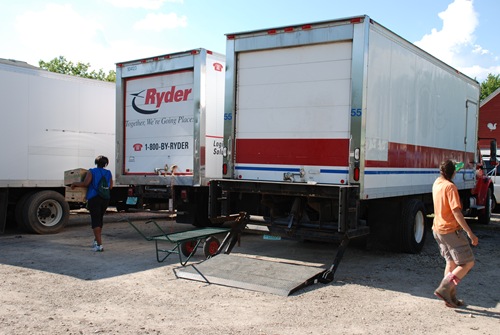
Here are some of the delivery trucks (for compost scraps?) These guys are not messing around!
Barnyard animals galore:
A hoop house (plastic roof removed for the summer) has been massively loaded with vermicompost. We’re talking two feet of compost here, people! Wowza!
All of this on a single acre!
Thursday, May 27, 2010
What is a community garden?
An idea that people, plants, animals and earth are interconnected.
An action that feeds, heals, connects, and celebrates life.
*Credit to Mark Francis, who suggested a three-part definition of gardens.
Sunday, May 16, 2010
Slow Food Nation Victory Garden (San Francisco, CA)
I’m kinda sorry to say that this garden is no longer with us. It was designed as a one-season demonstration project (photo-op?) in front of San Francisco’s city hall, back in 2008. As you can tell, the beds, made from bags of straw, were meant for easy disassembly, and planted with annual vegetables and flowers.
The garden showcased urban, organic food production for Slow Food Nation and Victory Gardens 2008+, plus about a billion other sponsors, government agencies and non-profits that have jumped on the local food bandwagon. (Yeehaw!) Also, veggies were donated to the SF Food Bank.
Kelsey (the on-site coordinator we met there) explained that they really hadn’t been sure how well things would grow in these experimental plots. Fortunately, (with a lot of work by staff and volunteers) it turned out awesome.
Other city and state capitols have been sprouting more permanent gardens. The folks in Vancouver (Why are they always so ahead of the game?) and Maria Shriver in Sacramento are two examples. Growing food in public places has never looked so good!
Slow Food Nation Victory Garden
Friday, May 14, 2010
Growing Home (Chicago, IL)
Growing Home started out with a simple idea. The director Harry Rhodes described it this way:
We had this idea that getting your hands dirty and seeing something grow could really help change people, but we had no idea how it would work. We saw that people quickly became engaged. They felt like it was theirs: their farm, their chickens, their tomatoes. (source)
This market garden in south Chicago provides job opportunities for people who might otherwise have a hard time finding work or a positive role in society. Here people get to learn about growing food, earn some money, and simultaneously provide a valuable resource (fresh vegetables!) to the greater community.
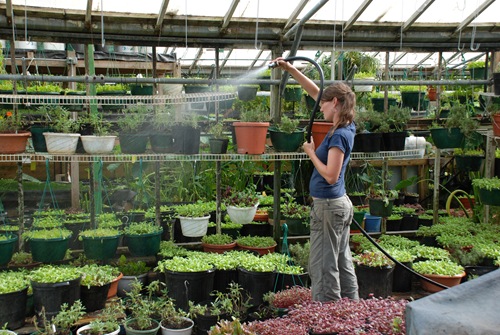
These greenhouses, on one of Growing Home’s farm sites, are where employees grow peppers, tomatoes, greens, squash and all kinds of other vegetables. Staff member Orrin Williams explained that this project is part of a larger vision for improving life in the community. The food grown here is sold at local markets and partnerships are formed with a growing number of “green collar” businesses bringing jobs and revitalization to the area.
Aside from this garden’s function and purpose, the site has some other interesting aspects. What amazed me the most was the fact that these vegetables are grown in less than 2 feet of soil. Why? Because the entire lot is paved with concrete, and the underlying soil is contaminated with industrial chemicals. So, the garden developers decided to leave the concrete in place (to prevent upward leaching) and simply add a couple feet of fresh soil. It’s incredible that it works, but it does.
In Chicago, so much of the urban soil has been contaminated, that it’s almost a boon to start a garden project with a paved site. That’s a pretty sad statement about the quality of urban soil, but it is impressive to see all the ways that people are managing to work around the challenge.
Monday, May 10, 2010
Green Youth Farm (Chicago, IL)
Green Youth Farm, run by the Chicago Botanic Gardens, gives teens a summer job growing real food.
Green Youth Farm has a few different sites, but the one I visited is in a lower-income neighborhood, north of Chicago. A select crew of teens hired from local high schools get to learn about farming, running a business, working as a team and leading their peers.
Produce is marketed locally and supplements the program funding. A group of young, full-time staff members also work alongside the participants. They organize the training and keep farm operations going throughout the year.
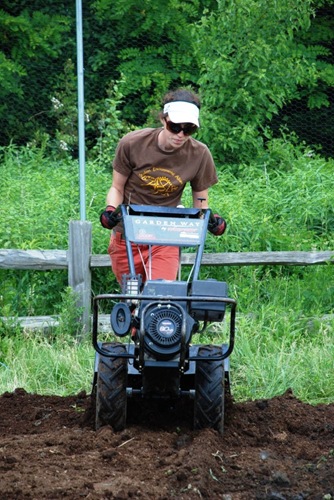
Visiting in June, I got to see the early stages of the season: tilling the soil, weeding, planting….
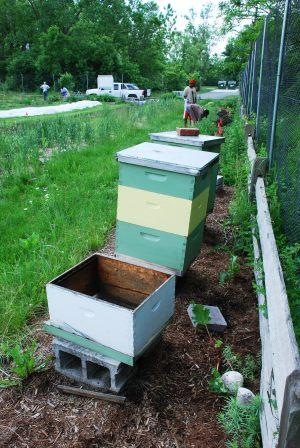
The farm also has a bee colony that participants learn how to tend(in full beekeeper regalia).
Overall, I was really impressed by the positive vibe at the farm. People were having a good time, enjoying being outside and working hard together. I could imagine the great experience these young farmers were going to have during the summer, something to be proud of.