Wednesday, April 14, 2010

Mill Creek Farm (Philadelphia, PA)

philly1

Like many good things, this urban farm was started by a couple of badass women. Just a few years ago they got permission from the city to build a mini-farm on this vacant lot in West Philadelphia, next to an existing community garden (which is pretty cool).

When I visited in July, they were harvesting like crazy and selling through a farm stand in front of the lot. They were also taking on high school interns and doing all kinds of cool  building/art projects on site.

philly2 philly3 philly4

The last photo above is their newly planted green roof. (That’s sedum, the ever-so-popular plant of choice for green roofs, precisely because it needs almost no water and the thinnest of soil to survive.) Pretty soon, if all goes well, the whole roof will be a carpet of green.

Mill Creek Farm

Monday, April 12, 2010

Alice Fong Yu School Garden (San Francisco, CA)

DSC_0550

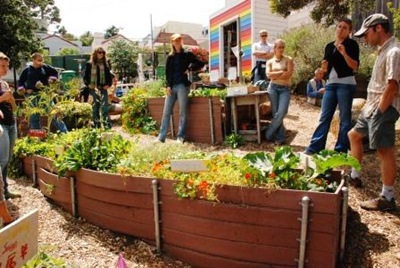
What a fabulous little school garden in San Francisco this is. I visited in September, when the apples (for the teachers?) were getting ready for school.

It’s just a little garden on a very steep hillside. The garden designers did some excellent work building terraced raised beds into the hill. I think those poles holding up the sides of the beds might even be the same materials used for playground equipment?

DSC_0528

We also got a presentation from the local school garden coordinator. Can you believe that’s really her job? This woman gets paid to go around schools, growing gardens with kids. Talk about a dream job.

DSC_0544

Gotta love the little details.

DSC_0540

Tuesday, April 6, 2010

Johnson Community Garden (Sacramento, CA)

CIMG3161small

The Johnson Community Garden is the smallest garden run by the City of Sacramento, and also one of the first built by the department of Parks and Recreation.

Smallness has its challenges: few plots, an enormous waiting list, little room for perennial flowers (with their bees and butterflies!), and a higher cost-per-gardener. Still, a small garden is better than no garden, right?

CIMG3158small

CIMG3159small

This is also the burliest raised bed I have ever seen!

Thursday, April 1, 2010

Urban Farming (Detroit, MI)

DSC_0030It’s hard to describe Urban Farming in a brief post. The founder, Taja Sevelle, explains it this way:

“We want people to see food growing all over the place, in yards, on rooftops, on walls, anywhere there is space,” she said. The one common denominator with all of the gardens is that they are open to the public. “There are no fences,” she said. “Anyone can take food from the garden.” (source)DSC_0101

DSC_0132

I visited Urban Farming a couple summers ago, and only spent an afternoon with some of their staff and volunteers, but what I saw was really cool: open garden patches, where anyone in the neighborhood could stop by and pick some food.

While I was there, one neighbor walked over to help a volunteer crew lay down some plastic mulch, and another neighbor showed up to harvest some greens. The staff said that people generally respect the gardens and appreciate them. The gardens—more like row crops—transform vacant lots into productive land and provide new opportunities for neighbors to get outside and meet one another. Most of all, they make fresh fruits and vegetables more available in places that really need them.

Growing food for public consumption is basically the same idea championed by Darrin Nordahl in his recent book, except that he goes even farther, calling on municipalities (not only donors and volunteers) to help create these kinds of food-producing landscapes, just as they would other services like parks and farmers markets.

Where is this all going to lead? I don’t know, but I’m excited about the work Urban Farming is doing, and appreciate the unique voice they bring to the urban agriculture movement.

DSC_0047

Urban Farming

Monday, March 15, 2010

Southside Community Garden (Sacramento, CA)

CIMG3180

So, this is the other 2/3rds of the garden that used to be Mandella Community Garden and got moved down by the freeway. Now it’s called Southside Community Garden (see mural). Probably the crazy/coolest thing about the garden is its rainwater cistern disguised as a giant ladybug!

CIMG3186

Gotta love the curvilinear gate, as well. I think that thing rising above the gate is technically called a bower. (I hear the artist was also going to include broccoli and shitake mushrooms in the composition, but it got nixed, for some reason.)

CIMG3177

At any rate, it’s always good to have some permanent features in the garden that establish a sense of place and permanency even when the garden is in its “flat and brown” phase of the annual cycle. Here’s a panorama of the east half of the garden, definitely looking a bit flat and brown. In a few weeks it’ll be raging, though:

CIMG3186 Stitch east

Southside Community Garden

Friday, March 12, 2010

Fremont Community Garden (Sacramento, CA)

Oh, man. It’s been way too long since I’ve posted a new garden here! Can my excuse be that it’s been winter, and the gardens haven’t been looking their most splendid, necessarily?

At any rate, I did get out to some gardens recently, and here’s one of my favorites, the Fremont Community Garden in Sacramento. This garden has an interesting history. Currently there are 50 gardeners growing food and flowers here, but originally the garden was even three times bigger!

CIMG3172

It all went down in the early 2000’s. The garden (called the Mandella Community Garden, at the time) had been there “temporarily” since 1960, and finally the city decided to get around to building housing on it. People got pretty upset about this, as you can imagine. There were fruit trees, topsoil, a sense of community, neighborhood involvement—the whole nine yards!

Well, after a series of costly lawsuits and protests (people chaining themselves to trees, etc.) the city development agency finally gave an inch and allowed 1/3 of the garden to stay. They moved the other 2/3 to a noisy lot next to the freeway.

It seems around this time the leftover garden also got a major facelift. They installed ADA accessible pathways (very nice), brick borders and a motley assortment of art installations.

 CIMG3171

On my tour around the garden, I was impressed by the winter veggies (4-foot fava beans! In March!), the abundance of perennials, and the extra work that some of the gardeners had invested in their plots. Here’s one of the plots that was really going “above and beyond.” Check out those terraces! CIMG3165

This lavender plant was a friendly greeting at the entrance to the garden. It was also abuzz with pollinators! I spied at least one giant bumbler in the flowers. (A visiting entomology class once identified over 20 different kinds of pollinating insects in this garden.)

CIMG3162

For a panorama of the entire garden, you can click on the image below. I took four photos and stitched them together with Windows Live Photo Gallery (which happens to be a free download-able program and highly recommended)!

CIMG3176 Stitch (2)

Fremont Community Garden

Tuesday, January 26, 2010

MLK Middle School Herb Garden (Berkeley, CA)

DSC_0532

DSC_0530 corrected

It’s worth noting that across from the Edible Schoolyard, there’s another garden right next to the cafeteria, a huge herb garden gifted by local garden organizer Beebo Turman and Eric Weaver.

On this wintery day the herbs most in force were rosemary  (so hardy!) lemon balm and rose-scented geranium. All very, very fierce smells. I wonder how the school and students have used these herbs so far. Cooking? Soap-making? Art projects? There seem to be quite a few possibilities.